

The blocks take up real space.
Everything on the belt is a real object with a size. A slab three cells wide needs three lanes running side by side, or it does not move at all. Get the routing right and the whole thing ticks over like clockwork. Get it nearly right and it clogs, which is where the name came from.
 Watch the trailer · 1:15
- Free demo available now
- No time limit, anywhere
- Deterministic simulation
- Ranked seeds in the full game
- Made by one person
Real space
Three cells wide needs three lanes
Most factory games move one item per tile. Here the thing on the belt is a body with a width and a height, and it needs the room. Even the first extractor you place has a mouth three lanes wide, so you are building a bus before you have built anything else.
Shape decides everything downstream of it. A T-piece will not take a corner the way a rectangle does. Two blocks can settle beside each other and jam a turn that neither of them would have jammed on its own. Sometimes you rotate a piece to squeeze it through a tight spot. Sometimes you don't, and it sits there with everything behind it backing up.
One three-lane bus. The single cell leaves two lanes free. Everything wider takes the whole road.
Consequences
Nothing disappears
Delete the belt under a block and the block stays where it is. The Core is the only thing in the game that consumes anything. You cannot bury a mistake under more conveyor and hope it sorts itself out. You have to go over there and clear the jam.
It is harder to work this way and that is deliberate. Tearing up a bad line and rebuilding it properly is most of the game, and a junction you were happy with last week stops working once the pieces coming down it get bigger.
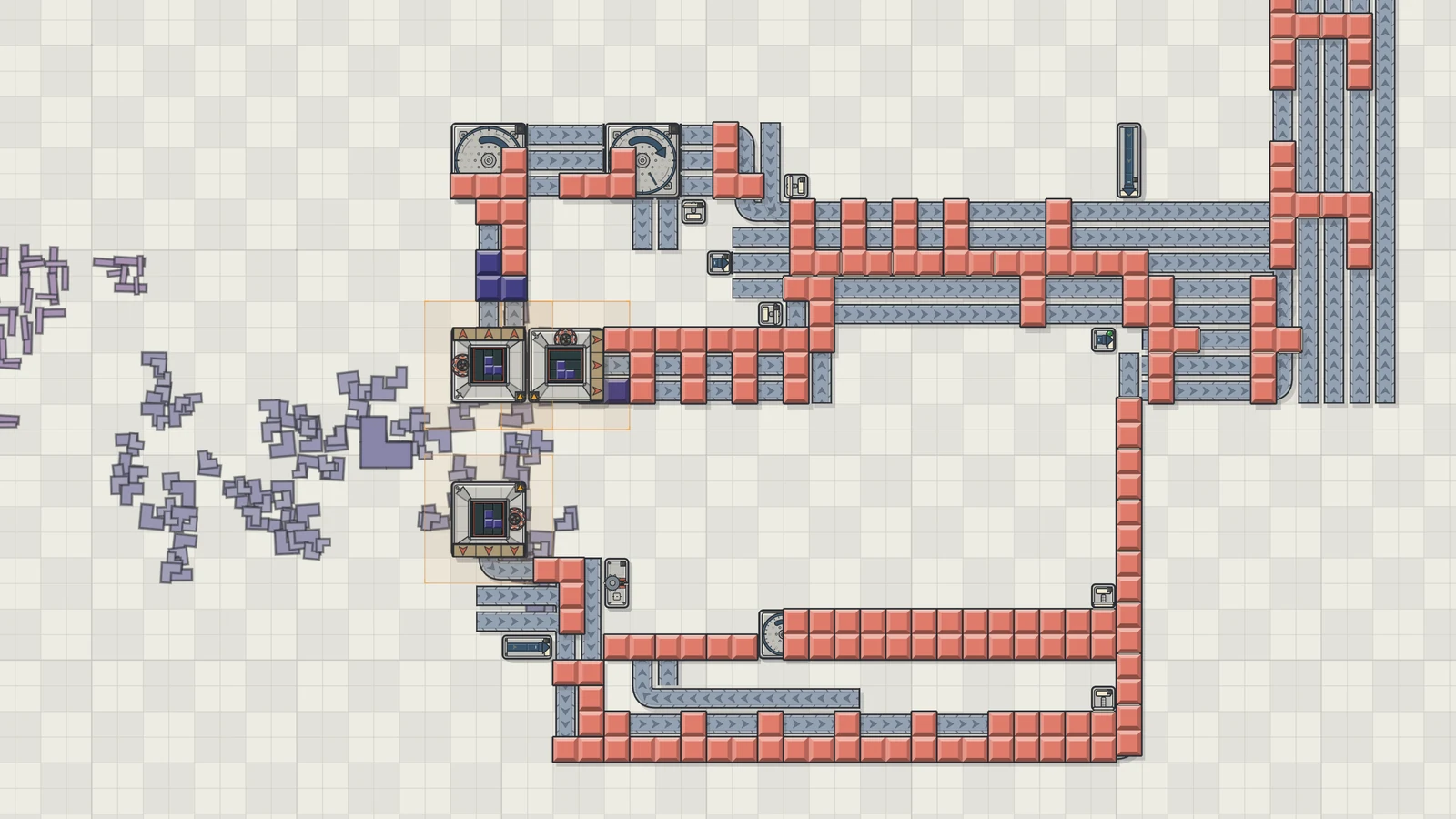
A starter factory. The loose pieces off to the left are lying exactly where they were dropped, and they will stay there.
The toolkit
Glue it, cut it, push it, route it
Belts, underground conveyors, routers, turntables, glue heads, cutters, pushers, stop posts and gates.
A glue head paints the side of every cell that slides past it, and where two painted faces meet the blocks weld into one body. Both sides have to be glued. A cutter's blade comes out of the line running through its own middle, so you aim that line at wherever you want the block split, and one cutter cuts one cell deep.
A pusher shoves a whole body one cell however big it is, and you stack pushers one behind the other for a longer stroke. The body stops on whatever it hits, so the stop sets the position rather than the number of pushers. What you do with all of it is turn raw material into the exact figure the Core is asking for.
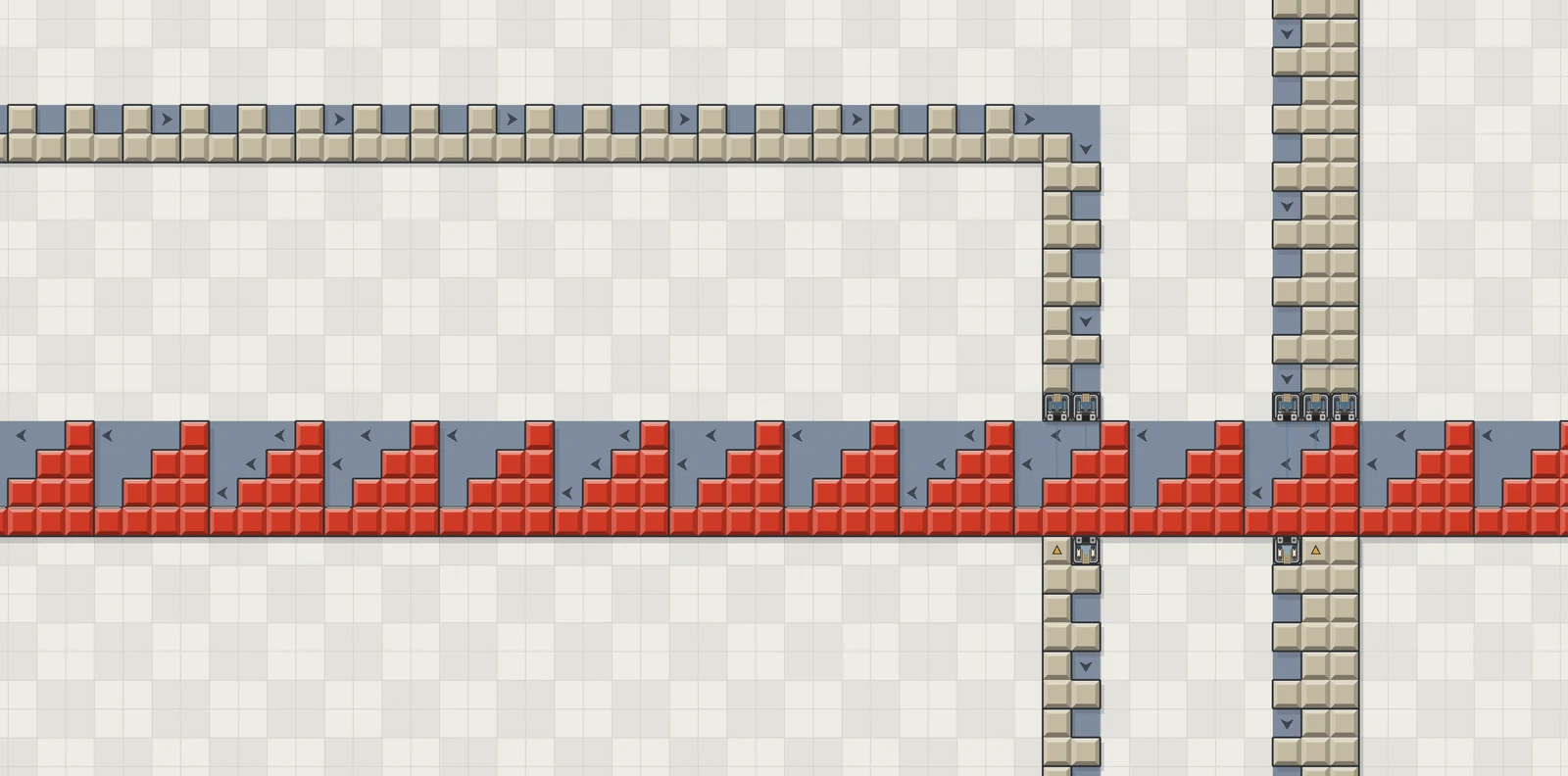
Roof pieces on one lane, wall blocks on the other, crossing at a junction. Every one of these was cut and welded to shape further up the line.
Logic
Wire it up and it runs itself
A reader sits beside a lane and describes whatever is in front of it onto a cable. Run that cable into a counter, a lamp, a combinator, or a gate that only opens while the wire is carrying something.
Filter by colour, by size, or by how many cells a piece has. Decide what gets cut, what gets pushed and what gets left alone. You can hook almost anything into the logic layer and control when it acts. There is no single way to solve any of it, and how you build it is up to you.
A reader beside a two-lane bus, a decider testing width = 2, and a pusher wired to obey it. Two-wide bodies get rammed onto the divert lane. Three-wide ride past untouched.
Scoring
The same shape can be worth more or less
You are scored on figures per minute, and there are two ways to move that number. Deliver more figures, or deliver them better. Every cell inside a single welded piece is worth more than the one before it.
So the same 3×3 comes to 9.0 if you built it out of nine separate single cells, 10.0 from two Ls and a bar, and 12.6 if you mined all nine cells as one block. Cutting everything into little pieces and gluing it back together will hit the shape, and it will always score you the least.
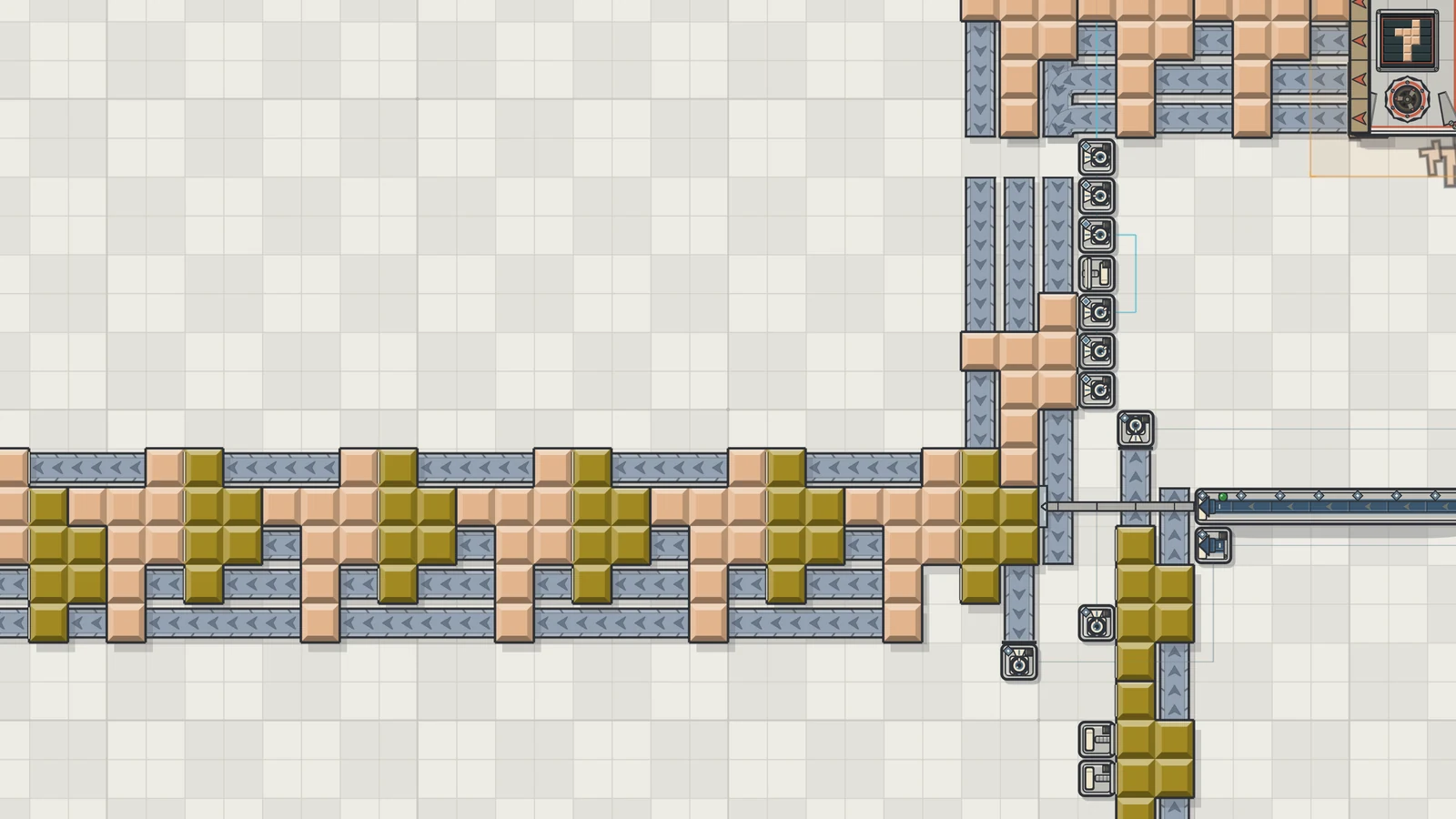
The same 5×2 delivered twice. Glued together out of two mined bars the Core pays 12.0. Mined whole, it pays 14.5.
The floor
It starts small and it does not stay small
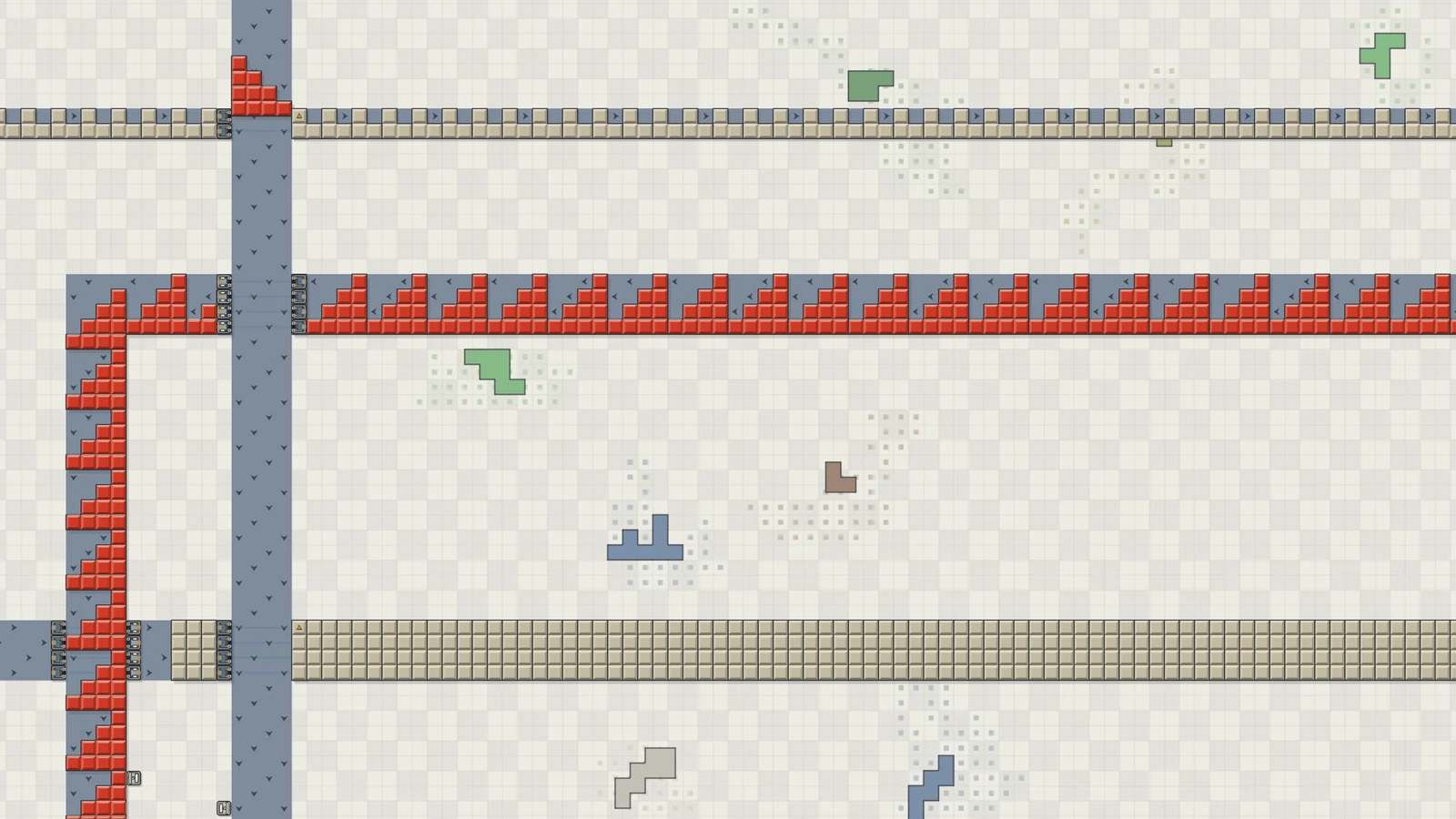
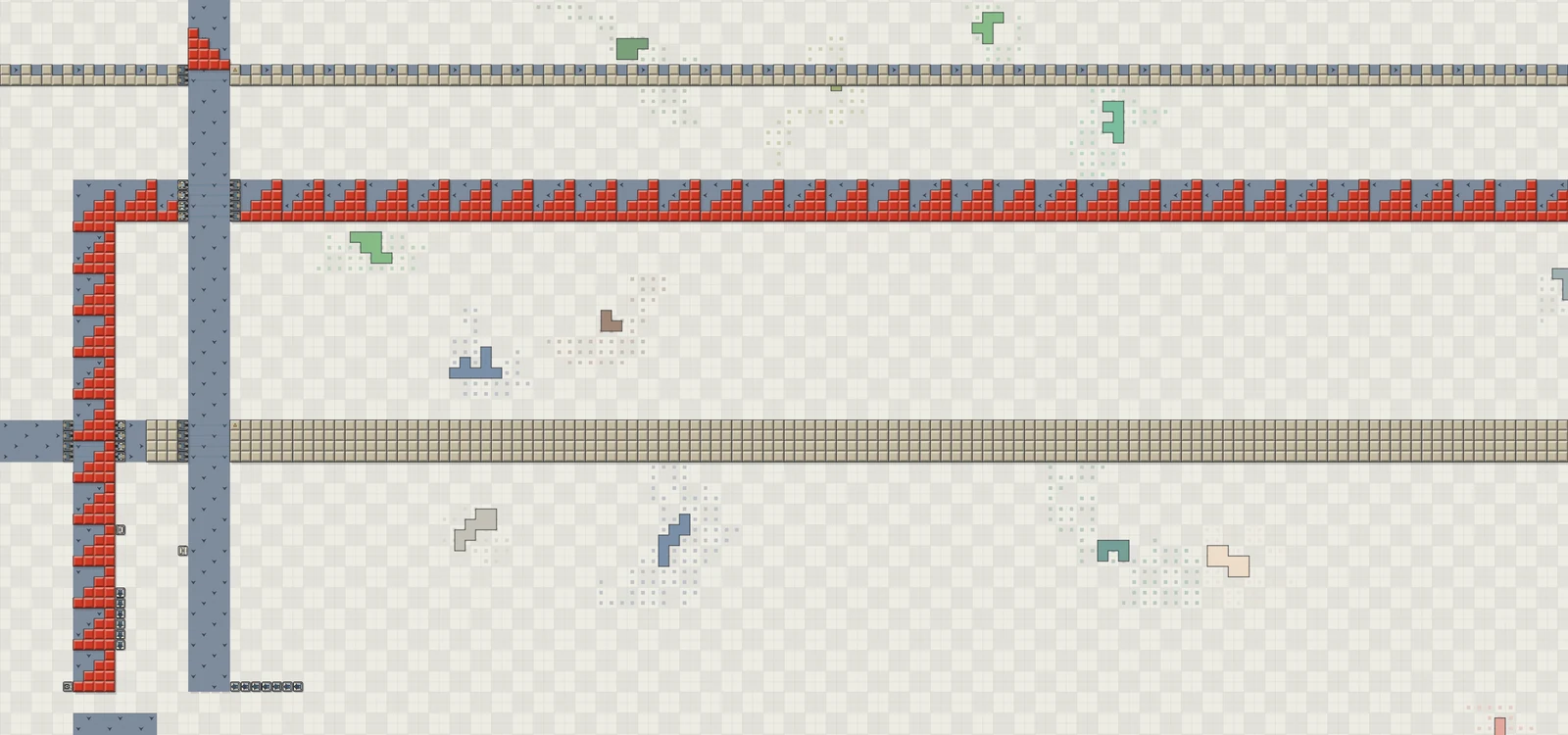
What you get
Play the demo now. Full game 10 November.
The demo
Free · Available now
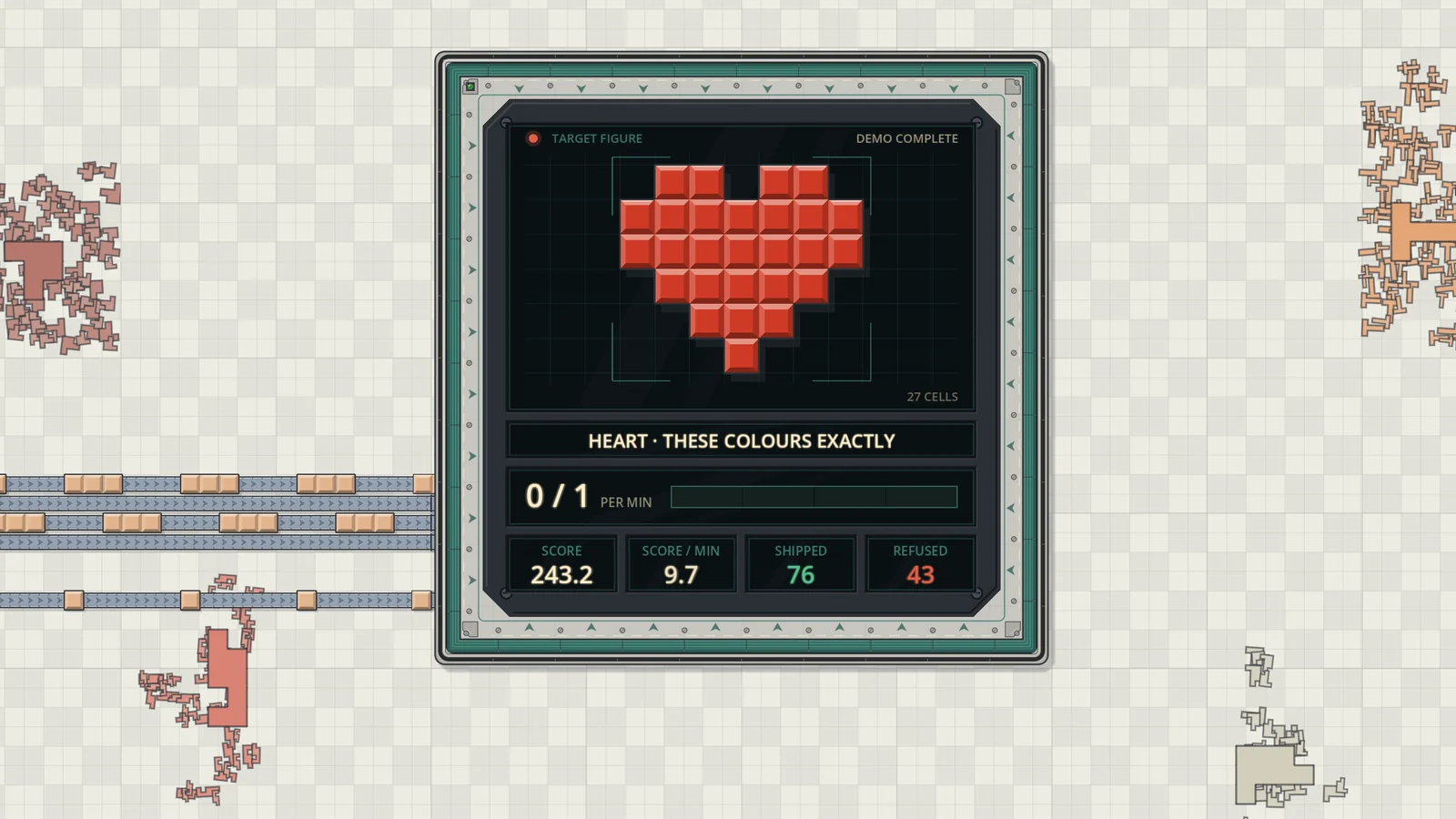
Three figures to build. Twenty 1×3 bars to start, then ten chairs, then a house where you have to get the colours right as well as the shape — white walls, red roof — at three a minute, held for three minutes running.
There is no time limit and nothing can be failed, so take as long as you need to work it out. After the house it stays as an endless ask, and you can keep rebuilding the same factory to push the rate higher.
- The whole machine set, not a cut-down one.
- The same maps and the same seeds the full game runs on.
- Not ranked. Leaderboards belong to the full game.
The full game
10 November 2026
- Many more figures. Seven tiers, up to pieces as large as 32×32. The machine set is the one you already learned. The shapes stop cooperating.
- In-game leaderboards. The first hundred seeds each get their own board. Two players on the same seed start on exactly the same map, so the only thing that differs is the factory.
- Game modes where using the logic layer gets harder.
- Steam Workshop. Build your own target figures and share them, or take somebody else's.
- A screenshot mode that exports your entire factory as one enormous image.
- A miniaturisation machine that shrinks and enlarges pieces, so tiny cells and huge ones can go into the same figure.
- Achievements. Just achievements, to show you know what you are doing.
Run it like clockwork, or watch it clog
The free Clogwork demo is available now. The full game launches on 10 November 2026. Download the demo, and wishlist the full game while you are on its Steam page.